
When One Part of the Farm Feeds the Next
August 18, 2026
One of the things I am starting to love about farming is how often the answer to one problem is sitting inside another one.
When we raised our first batches of chickens, I mostly thought about the obvious things.
Feed them. Keep them healthy. Move them onto fresh pasture. Eventually put good chicken on people’s tables.
But chickens leave something behind.
A lot of it.
Our brooder is filled with wood chips, bedding and manure. By the time the birds move out onto pasture, what is left behind looks like a giant mess.
Except it isn’t really waste.
It is fertility.
Once composted, all that manure and carbon becomes incredibly rich organic matter.
And that got me thinking.
What should we do with it?
The normal modern answer is often to treat every part of a farm as a separate business.
You raise chickens over here.
You buy fertilizer for the garden over there.
You buy vegetables from somebody else.
You buy sauce from somebody else.
Everything comes in on a truck and everything leaves on a truck.
But nature doesn’t really work like that.
There is no garbage truck in a forest.
A tree drops its leaves. The leaves feed the soil. The soil feeds fungi and insects. The fungi and insects feed other things. Eventually those nutrients find their way back into another tree.
What looks like an ending is usually the beginning of something else.
And the more I farm, the more I think a good farm should probably work the same way.
Not perfectly closed. That is probably impossible.
But always trying to close the loop a little more.
So this fall, Lindisfarn is starting another experiment.
We are planting garlic and preparing a new no-till garden patch.
Next spring, the plan is to plant more than 400 hot pepper plants.
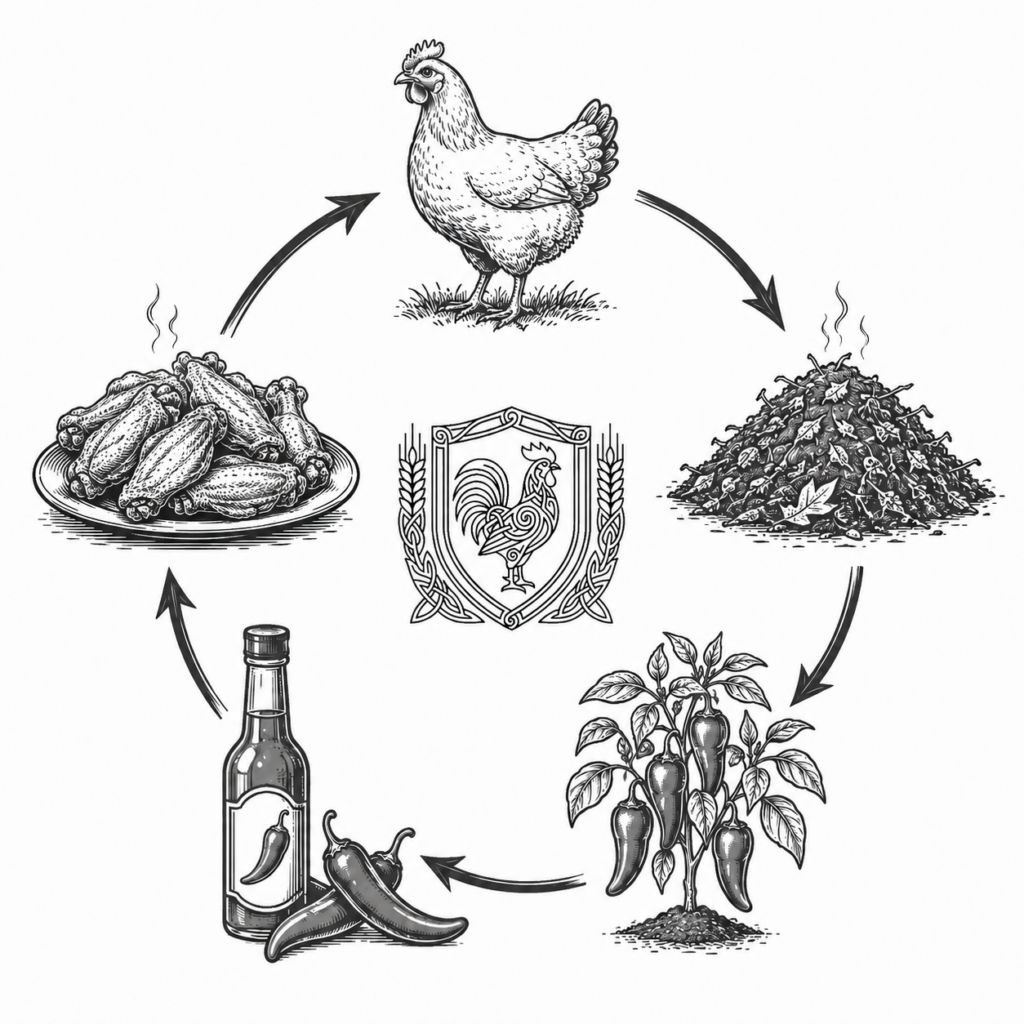
The compost from the chickens will help grow the peppers and garlic.
Those peppers and garlic will become hot sauce.
And eventually that hot sauce will probably end up right back on the chicken.
Chicken → compost → peppers and garlic → hot sauce → chicken.
There is something deeply satisfying about that.
Maybe because it feels less like manufacturing products and more like building a farm.
The chicken isn’t just a chicken anymore.
It helps create fertility.
That fertility creates another crop.
That crop creates another product.
And instead of constantly asking, “What else can we buy to produce something?”, you start asking a very different question:
What is the farm already giving us that we aren’t using yet?
That feels much closer to how agriculture should work.
There is another reason hot sauce made sense.
I’ve actually been making it for years.
Small batches in the kitchen. Different peppers, garlic, fermentation, vinegar and whatever else I felt like experimenting with.
Mostly I gave the bottles away to friends and family.
Then people started coming back asking for more.
Which creates an interesting business problem.
At some point, if people keep asking you for the thing you are giving away, perhaps you should stop giving all of it away.
So we started thinking a little bigger.
What if we didn’t just make the hot sauce?
What if we grew it?
What if the fertility for those ingredients came partly from the chickens we were already raising?
And suddenly something that started as a hobby began fitting into the ecology of the farm.
That is the part I find exciting.
I don’t really want Lindisfarn to become a collection of unrelated products.
Chicken.
Garlic.
Peppers.
Honey.
Sheep.
Whatever comes next.
That would just be a grocery store with extra steps.
What interests me is when each part makes the other parts stronger.
The chickens improve the soil.
The soil grows crops.
The crops become food.
Some of those crops might eventually feed animals.
The animals create fertility.
The fertility goes back into the soil.
Round and round it goes.
You start to realize that the productivity of a farm isn’t only about how much you can extract from an acre.
It is also about how many useful relationships you can create on that acre.
That’s a very different way of thinking about growth.
So for now, we are starting small.
A pile of chicken compost.
Some garlic going into the ground this fall.
A few hundred pepper plants next spring.
A lot of recipes to test.
And eventually, hopefully, a bottle of Lindisfarn hot sauce sitting beside a pasture-raised chicken that helped grow it.
There is still one very important question we haven’t answered.
What kind of hot sauce should we make?
Garlic-forward?
Smoky?
Sweet heat?
Properly hot?
Or the kind that makes you reconsider your life choices?
Because apparently building a more closed-loop farm also requires arguing about peppers.
More from the journal
- Read →
Priced Out of the Land, Regulated Out of Farming
- Read →
Chick Day 2026
- Read →
Learning to Live Within Limits
Curious how the birds are raised? See how we raise them.